What's up in
Mathematics
Latest Articles
Is AI the End of Math As We Know It?
Mathematicians are facing the sudden shift with grief, anger, and a desperate search for fresh ideas: “If we don’t adapt, there’s just no more math in 50 years.”
What Does the Fourth Dimension Actually Look Like?
Maggie Miller explains why our intuition about three dimensions breaks down in four, and how she visualizes 4D spaces as a reel of three-dimensional snapshots.
Mathematicians Harness Randomness To Crack a 55-Year-Old Conjecture
After a long hiatus, the problem, which was likely inspired by juggling, has finally been resolved by a group of young mathematicians.
Mathematicians Build Long-Awaited Graph Sandwich
The proof of a decades-old conjecture has given researchers a new way to understand complex networks.
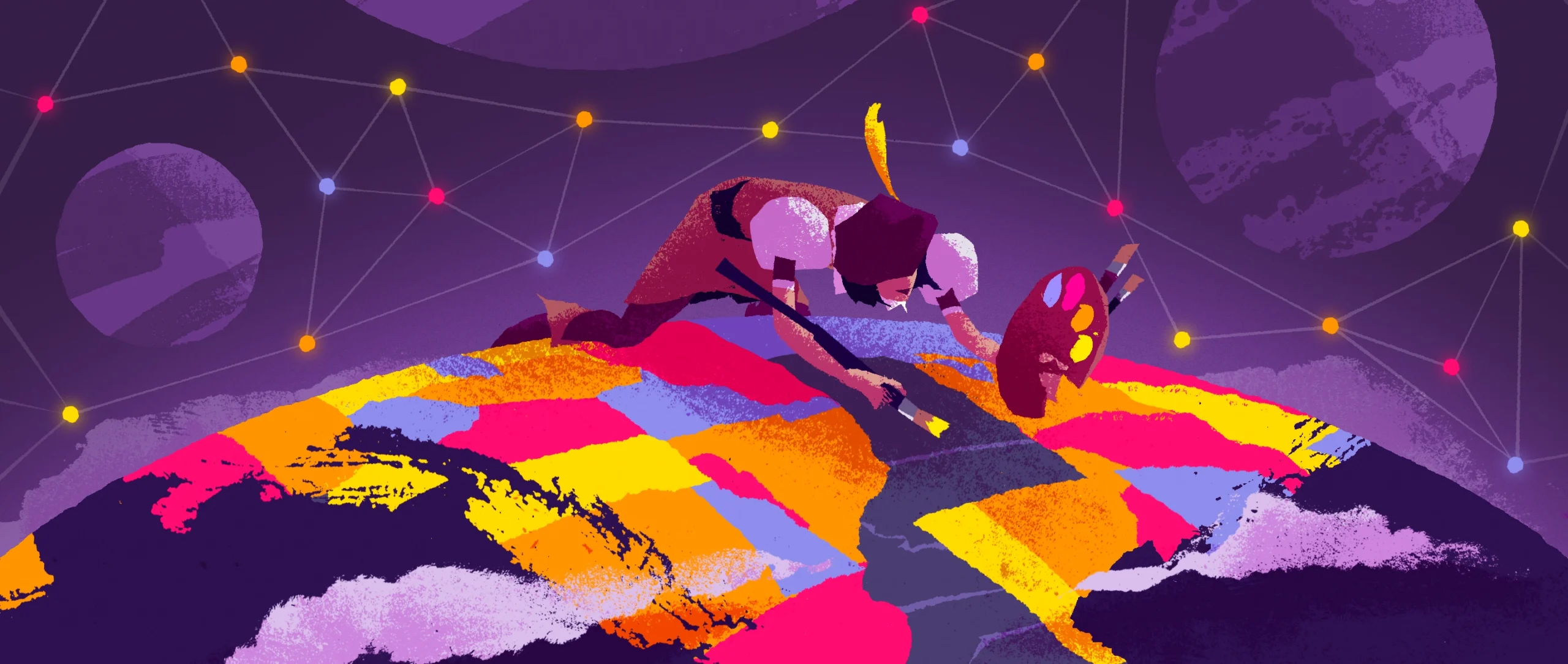
The Four-Color Theorem Gets a Rare New Proof
By revisiting the famous problem — which was controversially solved in the 1970s with the help of computers — mathematicians have gained important new insights into the nature of graphs.
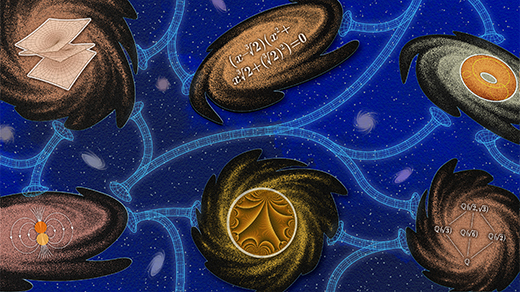
What Is Math’s Mysterious Langlands Program Really About?
Hidden correspondences hint at a deeper structure to the mathematical universe. Our columnist unpacks one of those connections and asks mathematicians what they might mean.

AI Has Solved One of Math’s $1 Million Millennium Prize Problems
Mathematicians at OpenAI showed that the Navier-Stokes equations, which describe how fluids flow, can sometimes “blow up.” But the massive result is not without controversy.
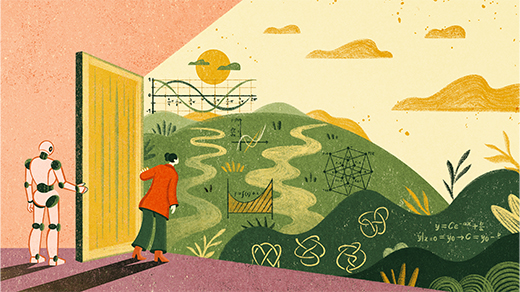
Live from ICM 2026: What Is Math For in the Age of AI?
In this special live recording from the International Congress of Mathematicians in Philadelphia, July 2026, the central question discussed was what do mathematicians really value about doing mathematics in the first place?
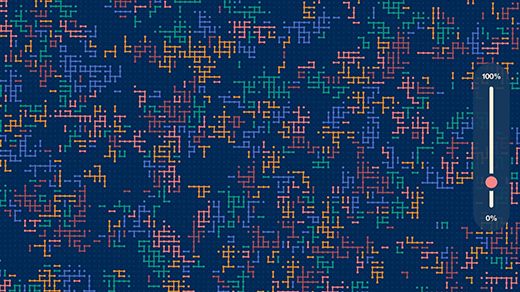
‘Stunning’ Percolation Proof Solves Decades-Old Puzzle About Phase Transitions
Mathematicians found that a broad class of networks will abruptly shift behavior past a critical point.